Internment
Episode 8 The Black Forest

Episode 7 Recap


My aunt and uncle were deported and put on a train for a second time which landed them, after three days travelling without food and water, in the depths of the Black Forest. There were different camps, Bad Wurzach where most of the Jersey deportees were sent, Biberach, mostly Guernsey residents, and Laufen which was mainly populated by single men. Men and women were separated as before in different accommodation but were allowed to mix during the day.
They arrived as the 1940/41 winter was setting in. My aunt and uncle remembered the intense cold many years later, as when, in their very comfortable sitting room with several dry sherries inside them, they pulled out lots of ephemera from those days. Their compatriots were from all walks of life, among them were artists who made cards for birthdays and anniversaries and drew cartoons of daily life in the camp. They made great friends while they were there, but never made any attempt to contact them afterwards. Not even a Christmas card, but then none of my relatives talked about those years between themselves, only threw me scraps sometimes which gave me a peep into the hardships they suffered. I coveted the memorabilia and thought down the years that I would ask them for it. I left it too late. After Kay died Arthur went into a home and I asked him what had become. He merely growled ‘Useless, who’d want that?’ He had burned it all before moving into the home. I could have cried.
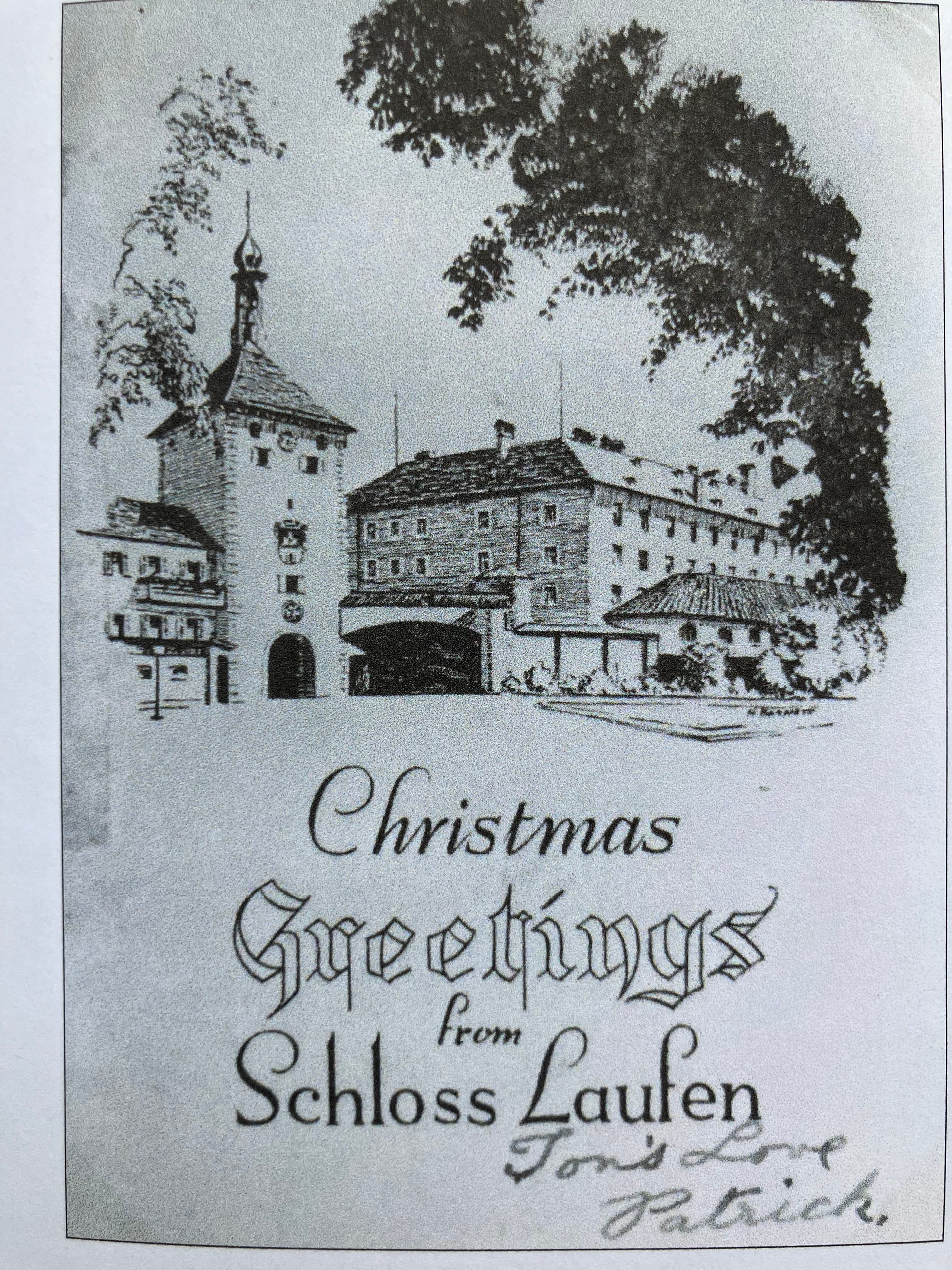
Kay and Arthur’s biggest complaint, even years later, was not the discomfort, the separation from the island and family but that they had been sent to Biberach, where the Guernsey deportees had been sent, and not Wurzach, where the majority of Jersey people were housed, which maybe why they didn’t contact fellow internees afterwards. It may seem trivial to you dear reader, but the antagonism between these two small islands goes way back and continues to this day. I don’t know when it started but was prominent during the Civil war 1642/51 when Jersey’s Royalist sympathisers sheltered Prince Charles (later Charles ll) in exile, while Guernsey were for the Roundheads and Cromwell.
The friendly insults live on. Jersey people are ‘Crapauds’ (Toads) and their neighbours are ‘Donkeys’. In case you think it’s a bit jokey and very ‘Clochemerle’ (for those old enough to remember the books or TV series), it’s more serious for both populations as if we had some reciprocity between the governments of the islands, there would be an economy of scale which would benefit us all.
The insular attitude noticeably affects people who travel from and to the islands, (which is most of us, either to see family elsewhere or to get to mainland Europe) as for years we had a ferry company that served both islands. Last year, when it was time to renew the contract, both islands jointly asked for tenders and then, after months of vacillation, Guernsey signed with one company and Jersey with another, so now we do not have the coordination and cooperation we used to have. My experience of the routes to both St Malo and Portsmouth with the new company, is that we now have an inferior service to which we are contracted for many years.
Rant over, I digress, back to the camp.
The huts the islanders were housed in were long and low with doors at either end which were locked by the guards every night after roll call. Kay said because they, the internees, were low risk, the guards stationed there were not the brightest crack troops and it was fairly easy, after they had settled into a routine, to fool them in small matters. The guards were methodical and obeyed orders to the letter, so when the huts ran out of wood for the small stove in the corner of the rooms, and some of the men chopped up one of the exterior doors for fuel, the guards still diligently came into the block, locked the door at the end and marched through, ignoring the gaping hole where the other door should have been.
The men were detailed to go and collect wood from the forest and at first the committee refused to cooperate, but quickly came to realise that it was in their own interests to collect as much as they could to bring comfort to themselves, their wives and children.
When searching the Jersey Archives for information on detainees, I was lucky enough to discover the following letter from Arthur to his directors at De Gruchys sent on 11 July 1943, obviously in reply to an invitation sent earlier. It was difficult to read in places but I’ve transcribed it as best I could.
Gentlemen
I have received letters from Mr Pierce, Mr Anderson and Mr Mousans, so write my thanks and hope this arrives for the third Friday in August. How I wish I could join you for that tea party even tho’ there is no tea. At the moment could I supply the cigarettes as have had several parcels from England, which helps a lot to make life tolerable.
Weather for July so far this month is deplorable – windy, cold and wet, all we can do is to sit about on our wooden beds and try to get on each other’s nerves as little as possible. We would give anything for a comfortable seat – (we only have stools) – and bed. This latter is wood, two tier with mattress and pillow filled with wood fibre. My barrack holds 86, with ordinary brick floors, unfinished … walls. … Our room, approx. 14’ square contains six and in it we eat, sleep and have our being. A small combustion stove in the corner but no fuel in summer, precious little in winter. We are supplied with one hot meal a day, midday, a quite good soup; hot water from the kitchen…
Sadly the rest of the letter didn’t survive but there’s enough to enable us to picture their conditions. When I was asking them about rations, I wasn’t aware they got parcels from England. It seems very strange to think the postal service between warring countries was still working near to normal. Later they got Red Cross parcels, or maybe they were the parcels from England. From these they were able to send some food home to Jersey and Auntie Roselle said it saved them when things got really desperate in the autumn of 1944.
The internees tried to maintain a semblance of normality for the children. After morning rollcall there was little for the women to do, so they had books sent out from England or Jersey, both for pleasure and to teach the children lessons. Kay said life was very dreary. The only excitement was an escorted walk into the village sometimes where they met villagers suffering as many, if not more hardships, than themselves.
I’m going to leave Kay and Arthur in the camp for now and next month we’ll go back to Jersey to see how the family was faring under not just German rule, but by now
the Nazis had arrived, bringing with them a harsher regime, to ensure that Hitler’s dream of an ‘island fortress’ was carried out.
Thanks for reading or listening. This newsletter will be free for the foreseeable future. I have no plans for a paywalls I would love it if you subscribed for free
§§§§§§§§§§§§§§§§§§§§§§§§§§§§§
I’ve read
The Dutch Orphan by Ellen Keith Wartime story of the German occupation of the Netherlands in the Second World War. Very much part of research for my own project, but I thoroughly enjoyed this story in its own right. It’s about two sisters you take very different routes through the German occupation.
Joanna marries the zoo vet and organises clandestine concerts using Jewish artists. Her sister marries a chemist who becomes a Nazi sympathiser. The two sisters have a very different experience of the occupation. It’s a fascinating story and it demonstrates how very difficult life was made for the inhabitant of any country that was occupied. If you like historical fiction I really recommend it.
By the edge of the sword by CB Hanley If you like mediaeval mysteries, whodunnits this is for you. It’s not the first in the series it’s about the sixth or maybe even the seventh, I can’t remember, but you don’t need to have read all the rest to get into either the plot or the characters. There will be little clues to the back stories all the way through. It’s a fast read, about five hours so it’s good for holiday or weekend. It’s very entertaining and I’m not telling you the story cause it’s very complicated. All you need is that it’s squires, ladies, serfs, grooms, murder and horses, but not necessarily in that order. That about covers it.
I’m listening to Intermezzo by Sally Rooney and Glorious Exploits by Ferdia Lennon. But not often and not for long because I can’t get into them, either of them. I know - it’s sacrilege not to worship them both, but I say what I see and I’m not hooked on either of them. So there!
I watched the first series of The Night Manager on BBC Iplayer to get ready for the second series and it was as good as I remembered it. Hugh Laurie was wonderfully evil as the boss of a shady arms dealing conspiracy and Tom Hiddleston was suitably enigmatic as the ordinary guy thrust into deception and skullduggery by Olivia Coleman for the British Intelligence Service. And now some of them are back and the first episodes of season 2 look promising. Definitely worth a watch.
It’s incredible what people endure in their lives. So fascinating reading these descriptions, Sue. Love the bit about chopping down the door!